
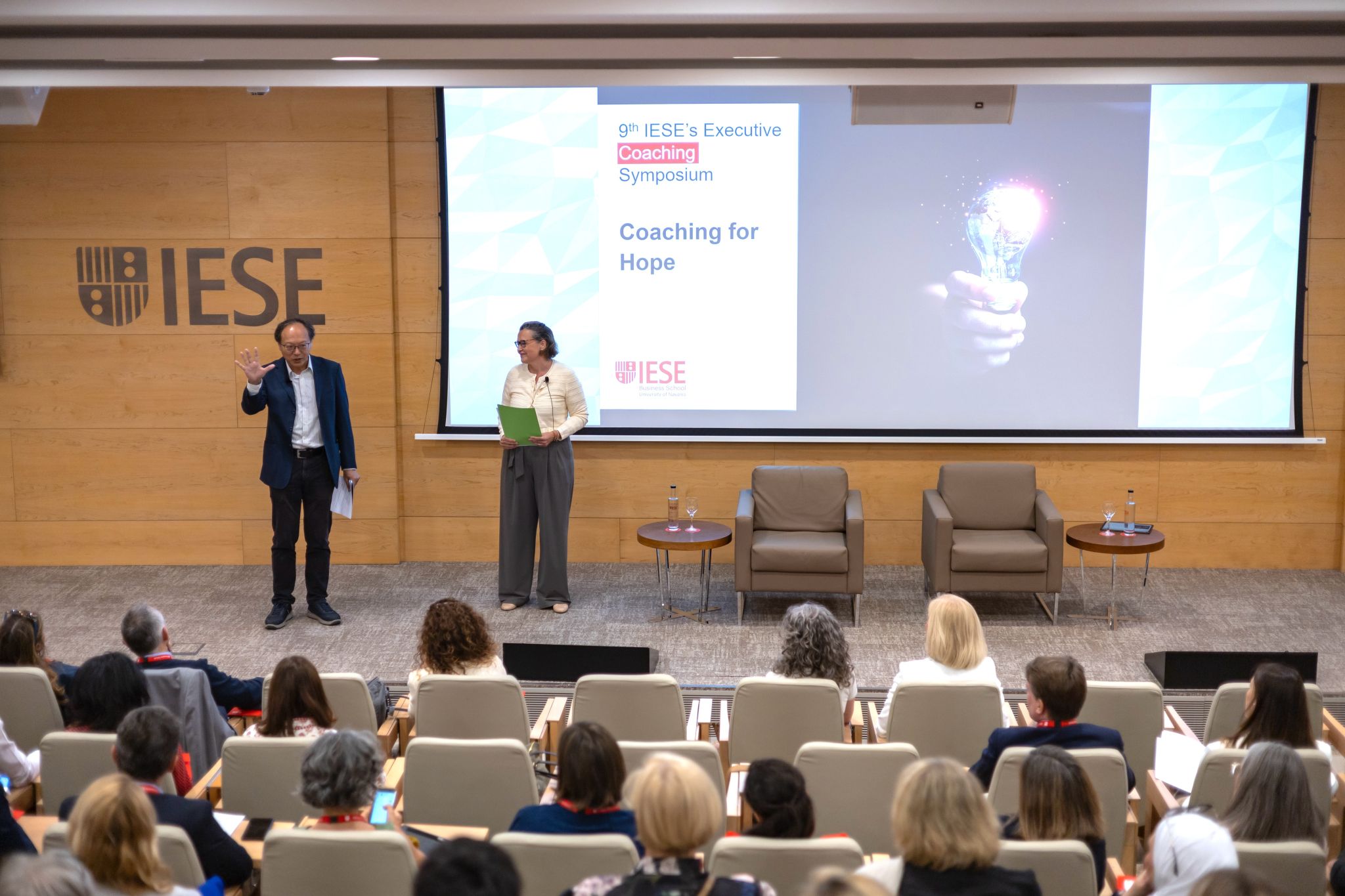
It’s not every day you find yourself surrounded by 170 coaches from all over the world—each one bringing their own lens, language, and legacy of leadership development. But that’s exactly what happened at the 9th International Executive Coaching Symposium, held at IESE Business School in Barcelona. I was honoured to be invited to deliver a session as part of the programme, and even more grateful to be part of a larger conversation about what coaching can and should look like in the world today.
The theme this year was “Coaching for Hope”. And right from the start, it was clear that this wasn’t going to be a series of vague, feel-good platitudes. The conversations were grounded, urgent, and deeply human.
Hope was framed as an active, deliberate practice. As one speaker put it, hope is a verb. We can sit around lamenting and waiting for things to get better or we can action—despite uncertainty, despite resistance, despite the very real challenges we face as individuals and societies.
Thanks to Professor Javier Zamora, who tackled the question of artificial intelligence and its implications for coaching. Rather than entertaining the usual “Is AI going to take our jobs?” narrative, he reframed it: How can we use AI to do our work better?
He reminded us that we had similar fears when computers first became mainstream. And yet, we didn’t lose relevance—we evolved. The key, he said, is not to resist the tools, but to integrate them wisely, staying anchored in what makes coaching irreplaceable: human connection, emotional nuance, and contextual judgement. It was a timely reminder that tools are only as powerful as the intention behind them.
As part of the symposium, there were two parallel sessions—opportunities for smaller, focused conversations to unfold in different rooms across campus. I had the privilege of leading one of these, titled “Managing Difficult Conversations with Emotional Intelligence.”
Seventy coaches joined me for this session. I knew immediately that this was going to be a special group, they were questioning, sharing, challenging. and adding their own lived experience into the room.
Managing Difficult Conversations with Emotional Intelligence.
We explored what makes a conversation “difficult”—and how it’s rarely the topic alone. Often, it’s the emotion underneath. The assumptions we carry. The perceived risks of saying something that can’t be unsaid. In coaching, we help others prepare for and navigate these moments, but we also have to walk that line ourselves. The session unpacked practical tools, but it also opened space for vulnerability. And as always, that’s where the richest learning happens.
I left that workshop energised—but also humbled. You don’t stand in front of 70 senior coaches and pretend to have all the answers. What I offered was a framework. What they brought was wisdom. And somewhere in that exchange, something meaningful happened.
Throughout the day, what stood out most was the level of generosity in the room. People weren’t guarding their ideas or holding back their stories. They were sharing—openly, honestly, and without ego. There were moments of disagreement, of course, but even those felt constructive. The kind of disagreement that sharpens your thinking, rather than shutting it down.
Beyond the sessions themselves, the informal conversations were just as rich. Walking between rooms, over coffee breaks, during lunch—these were the moments where themes deepened, where connections formed, and where the real community aspect of the symposium revealed itself.
A key takeaway for me was this: in our line of work, hope isn’t an abstract concept. It’s a core part of what we coach people towards. But we can’t coach for hope if we haven’t done the work ourselves. Hope without grounding is just optimism. Hope with grounding is fuel.
And in a world facing everything from geopolitical instability to organisational fatigue to personal burnout—coaches are being asked to help leaders hold space for uncertainty, conflict, change, and reinvention. We’re not cheerleaders. We’re guides. And guides don’t need to have all the answers—but they do need to know how to keep walking.
A huge thank you to Yih-Teen Lee and Estíbaliz Ortiz, the organisers of the symposium, for curating such a thoughtful, brave space for learning. What they created wasn’t just a conference—it was a call to step up. To be more intentional in our work. More present in our conversations. More courageous in how we help others face hard truths—with compassion.
As I reflect on the symposium a few days later, I’m reminded of something one of the attendees said during a quiet moment after our session: “The hardest conversations are often the ones that build the strongest bridges.”
That’s true in coaching. It’s true in leadership. And it’s true in life.