
What if the most valuable ideas you’ll have this year won’t come when you’re trying to think—but when you’re not?
We spend much of our time in focused mode—directed attention aimed at solving a problem or completing a task. It’s productive, logical, and linear. But for true insight, innovation, and complex problem-solving, we also need to engage the brain’s diffuse mode—a quieter, broader way of thinking that is often ignored in today’s productivity culture.
This article explores how your brain organises knowledge through something called a semantic network, the role of focused and diffuse modes in navigating that network, and why intentionally making space for diffuse thinking might be the smartest move you make this year.
The Brain’s Internal Map: Semantic Networks
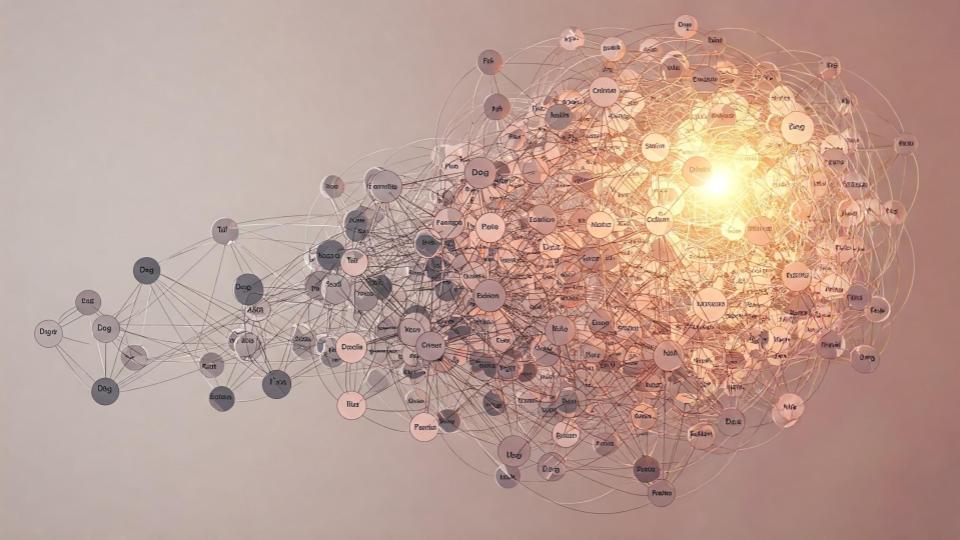
Imagine your knowledge as a network of interconnected ideas. Each concept you know—such as “dog,” “animal,” or “bark”—is stored as a node in your brain. These nodes are linked by associations like “is a,” “can,” or “has.” Together, these form what cognitive scientists call a semantic network.
When you think or learn, your brain activates specific nodes and travels along these links. The stronger the connections, the easier it is to retrieve and apply information. But just like any network, some paths are well-worn and obvious, while others are rarely explored—until the right moment arises.
Focused Thinking
Focused mode is the state we enter when we concentrate on a specific task. It’s essential for problem-solving, deliberate practice, and structured learning. Cal Newport refers to this as deep work – high-value, distraction-free thinking applied to cognitively demanding activities.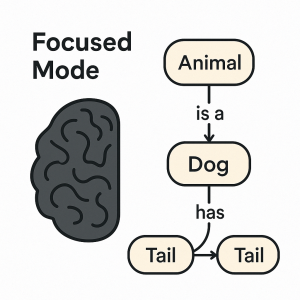
When you’re in focused mode, you move deliberately through your semantic network. For example, if you’re learning negotiation tactics, you might follow the path from “BATNA” to “anchoring” to “framing.” You’re strengthening direct connections, reinforcing familiar concepts, and gaining clarity.
Focused thinking is powerful. But it has limits. It works best with information you already understand and with problems that follow a logical sequence. It doesn’t always help when you’re stuck or need a creative breakthrough.
Diffuse Thinking
Diffuse mode is what happens when you stop consciously working on a problem. It’s your brain’s default network at play—activated during rest, light activity, or downtime. It’s what psychologists call the space where background processing occurs.
In this state, your brain doesn’t just travel the usual routes in your semantic network. It explores broadly, connects distant ideas, and accesses areas that focused thinking overlooks. This is where insight happens.
You’ve likely experienced it: struggling with a problem, giving up for a while, then suddenly finding the answer while taking a shower or going for a walk. That’s diffuse thinking at work.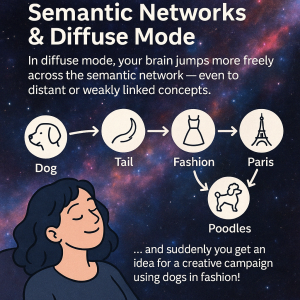
It might feel passive, but it’s not. It’s a different kind of cognitive work—creative, exploratory, and essential for innovation.
Cal Newport and the Case for Cognitive Space
Cal Newport’s concept of deep work focuses on eliminating distraction and cultivating intensity. However, his other key recommendation—the importance of solitude and downtime—aligns closely with the principles of diffuse thinking.
Practices like tech-free walks, scheduled boredom, and reflection time create the conditions for diffuse thinking to emerge. Newport’s idea of “productive meditation” – where you walk while lightly considering a problem – is a hybrid of focused and diffuse thinking. It gives your brain just enough structure to stay oriented, but enough freedom to roam.
By oscillating between intense focus and deliberate mental rest, you support both types of cognition and give your semantic network space to reorganise, connect, and create.
The Feedback Loop: Why You Need Both Modes
Mastery of any skill, whether it’s negotiation, strategy, or leadership, requires both focused and diffuse thinking.
Here’s the cycle:
- Focused Mode: You load relevant knowledge into working memory and actively build connections.
- Diffuse Mode: You step back, let go, and allow new patterns to emerge in the background.
- Back to Focus: You return with fresh insights and can apply them more effectively.
This feedback loop strengthens your semantic network holistically—not just along logical pathways, but across creative and lateral ones.
Why Diffuse Thinking Needs to Be Scheduled
We don’t struggle to make time for focused work. We schedule meetings, set deadlines, and build habits around productivity. But diffuse thinking? That often gets left to chance.
The problem is, without intentional space, diffuse thinking won’t happen. Our minds are constantly occupied with notifications, emails, and content. There’s no mental breathing room.
Here are practical ways to build diffuse thinking into your routine:
- Walk Without Your Phone
Take a short walk without listening to a podcast or checking messages. Let your thoughts drift. This is one of the most effective ways to trigger diffuse thinking. - Create Micro-Gaps
Leave short breaks between meetings or tasks. Don’t immediately fill these moments with screen time. Instead, reflect or just pause. - Practice Intentional Boredom
Let yourself do nothing for a few minutes. Boredom can be a powerful trigger for diffuse mode. - Use Reflection Questions
Ask yourself a question before a break: “What’s another way to approach this problem?” Then, step away and let your brain chew on it. - Protect Solitude
Schedule time without input—no reading, no scrolling, just silence. This creates space for internal processing and creative synthesis.
Visualising the Difference
The image below shows a semantic network in focused mode: direct, efficient, and linear. It’s the brain zooming in on a specific part of the network. It’s powerful for solving defined problems.
But the second image represents diffuse mode: broader, slower, more exploratory. This is how creative solutions form, how insights from seemingly unrelated domains collide to create something new.
Both modes are vital. But we often overuse one and neglect the other.
Diffuse Thinking in Emotionally Intelligent Negotiation
In emotionally intelligent negotiation, the ability to pause, reflect, and consider perspectives beyond the immediate exchange is crucial. Diffuse thinking supports this by allowing negotiators to step back from rigid positions and access deeper insights about motives, emotions, and alternative paths forward. It enables the kind of mental flexibility required to reframe a tense moment, recognise subtle shifts in tone, or generate creative solutions that satisfy deeper needs. In high-stakes conversations, it’s often the space between the talking—the walks, the silences, the reflection—that allows emotional intelligence to rise above reactivity and drive real resolution.